

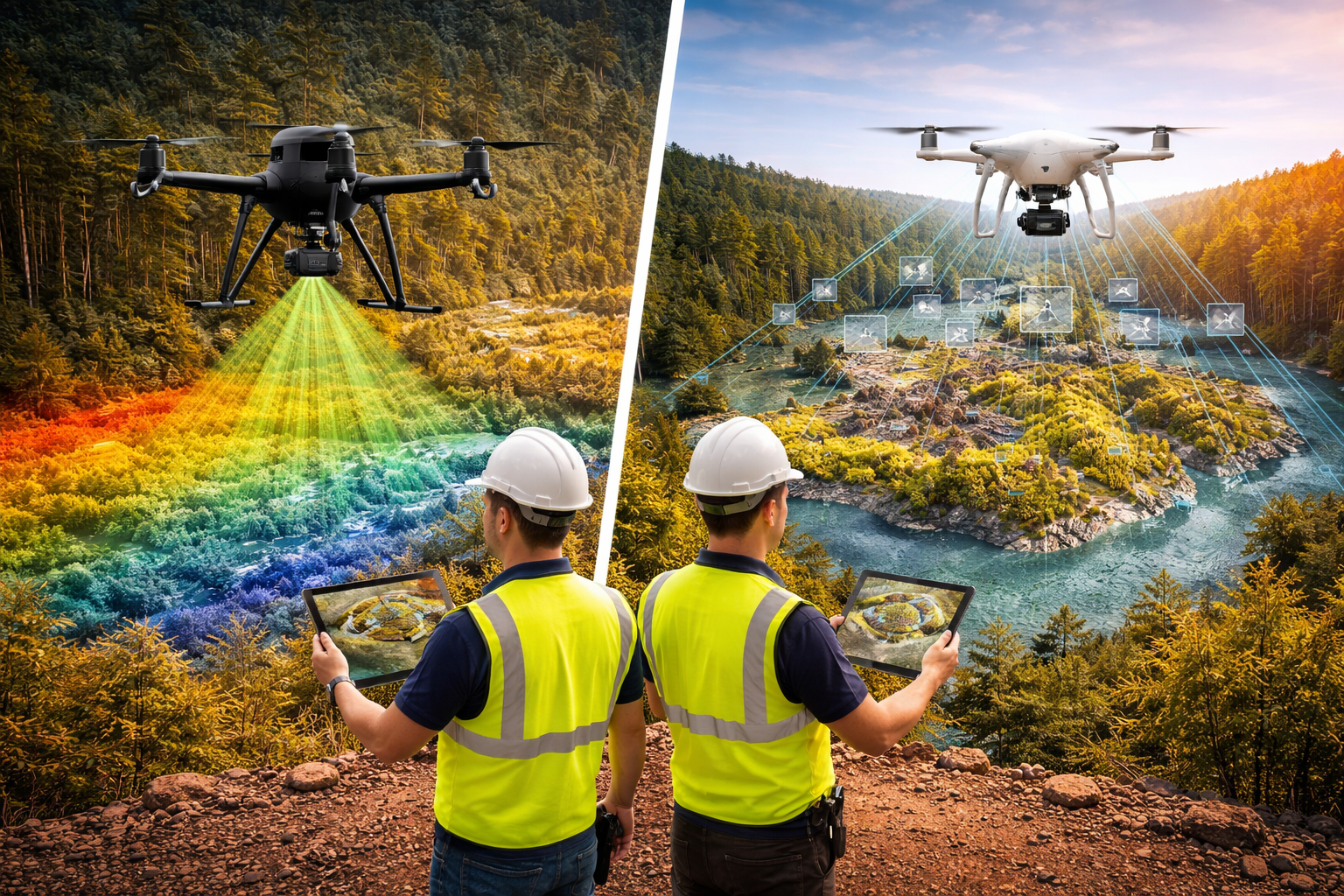
LiDAR vs Photogrammetry
What is LiDAR?
LiDAR surveying uses laser pulses emitted from a drone-mounted sensor to measure the distance between the aircraft and the ground surface. As the drone flies over a site, the LiDAR sensor sends out thousands of laser pulses per second and records the return time of each pulse. This process creates a highly detailed collection of points known as a point cloud, which can then be used to generate precise terrain models, elevation maps, and 3D representations of the land surface.
One of the major advantages of LiDAR technology is its ability to penetrate vegetation and capture ground elevation data even in wooded or heavily vegetated areas. This makes LiDAR especially valuable for large land parcels, environmental analysis, infrastructure planning, and terrain mapping projects.
What is Photogrammetry?
Photogrammetry uses high-resolution aerial photographs captured by drones or aircraft to create detailed maps and 3D models. Specialized software analyzes overlapping images to identify common points and reconstruct the terrain digitally. This method produces accurate orthomosaic maps, 3D models, and visual site imagery that are useful for site planning and project visualization.
Photogrammetry works best in open areas with minimal vegetation, where the camera can clearly capture the ground surface. It is commonly used for construction site monitoring, visual mapping, and surface modeling where detailed imagery is important.
Key Differences
While both technologies are powerful mapping tools, there are several important differences between LiDAR and photogrammetry.
LiDAR
Uses laser scanning technology
Produces dense elevation point clouds
Can capture terrain beneath vegetation
Highly effective for topographic and terrain mapping
Photogrammetry
Uses aerial photography and image processing
Produces detailed visual imagery and 3D models
Works best in open areas with limited vegetation
Ideal for visual mapping and site documentation
Understanding the Difference Between Two Powerful Mapping Technologies
Modern aerial mapping technologies have significantly improved the way surveying data is collected for engineering, construction, and development projects. Two of the most widely used methods are LiDAR (Light Detection and Ranging) and photogrammetry. While both technologies are capable of producing detailed maps and terrain models, they operate differently and are often used for different types of projects.
Ascension Surveying utilizes advanced aerial mapping technology to provide accurate geospatial data for projects throughout North Carolina and Tennessee helping clients choose the most effective method for their specific needs.
Choosing the Right Technology
The choice between LiDAR and photogrammetry often depends on the type of project, site conditions, and the level of terrain detail required. In many cases, LiDAR is preferred for projects that require precise elevation data or involve wooded terrain, while photogrammetry may be useful when high-resolution imagery is the primary goal.
At Ascension Surveying, we evaluate each project carefully to determine the most effective mapping method. Our goal is to provide clients with accurate terrain data, reliable surveying information, and efficient data collection methods that support successful project outcomes.
Whether using LiDAR scanning or aerial photogrammetry, our team is committed to delivering dependable geospatial data for engineering, construction, and development projects across the region.